
Walking through the halls of WCHS, Winston Churchill is everywhere: in the mascot, the motto and the pride students have. Yet there is no honest explanation of the man whose name is worn daily. When one thinks of Winston Churchill, they may think of the charismatic British prime minister who led his nation through one of the most turbulent and uncertain times in human history, defeating the horrors of the Nazi regime. Others may be reminded of his decades of imperialism and staunch white supremacy.
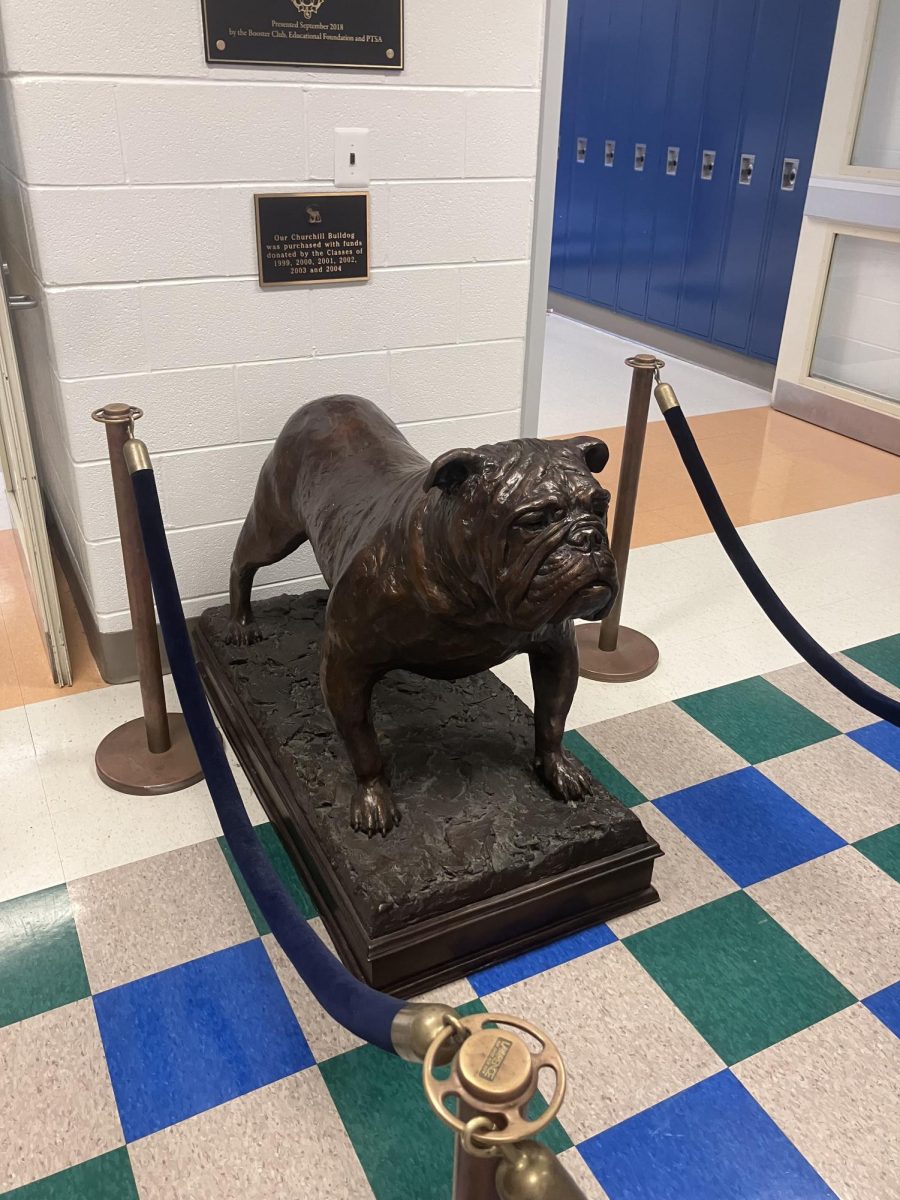
However, once stepping inside a school named after Churchill, just 15 miles outside the U.S. capital, one would find nothing representative of the man besides the name and mascot. Even then, the Bulldog, which is a reference not only to his looks but also his strong and ambitious nature, has endured multiple attempts at removal because of its violent connotations. Yet the issue is not that WCHS refuses to honor Churchill because of his racism; it is that there is almost no education about who he was at all, good or bad.
Such a lack of acknowledgement and education could lead one to believe that WCHS is perhaps named for a different Winston Churchill. Many students and staff simply do not know much about Churchill beyond his name and the vague idea that he was a World War II leader. This absence of education is especially troubling because Churchill was both a crucial historical figure and a deeply controversial one. He was an imperialist whose legacy includes racism. Churchill once said, “a stronger race, a higher-grade race, a more worldly wise race to put it that way, has come in and taken their place,” while talking about colonization in Australia and Africa.
Churchill’s racism and prejudice make a strong case for teaching his history as it was, but also raise questions about how this community chooses to remember him. If MCPS is going to keep the name and mascot, the solution should not be avoidance; it should be education. Furthermore, why is WCHS named after someone who was never a U.S. citizen and expressed disdain for the American nation? Given his contempt for the United States, along with his racism, what is needed is not to sweep Churchill’s shortcomings under the rug, but to acknowledge and educate on both his greatness and flaws. Students of color at WCHS could be hurt to hear Churchill’s views on those he deemed “inferior people,” but ignoring the man who makes its name and failing to educate students about him can sting worse.
Winston Churchill was a man with terrible morals and views of those who were not white, but he was also the man who helped stop the most disgusting and racist force in human history. In many Western countries, especially the United Kingdom and the United States, Churchill is remembered primarily as a hero of World War II. However, in other parts of the world, he is remembered very differently.
In India, many people remember him for policies that worsened the Bengal Famine of 1943, contributing to the deaths of millions. In Ireland, his harsh control and opposition to independence movements have left a deep rift. Across Africa and the Middle East, he is associated with defending British imperialism and infringing on the human rights of those he helped colonize. WCHS considers itself a “No Place for Hate” school, but how can it truly be one while silent on this controversy and on these global perspectives? WCHS should recognize both Churchill’s achievements and his failures, honoring him as the namesake while also acknowledging his flaws.
Although Winston Churchill’s actions are in the past, WCHS still lives in the wake of his legacy. WCHS’ name is meant to represent and honor the man; however, how can it truly do that without fully accepting and clearly teaching his flaws and accomplishments to the entire community? If WCHS is to live up to its motto, “where every student belongs,” it is necessary to understand the school’s namesake, recognize the story behind the name and create an environment where discussion of both Winston Churchill’s accomplishments and failures can flourish. WCHS is the heir to its history, community and culture. For WCHS to understand who it is, it must therefore understand its history. To quote Churchill, “Those who fail to learn from history are doomed to repeat it.”