
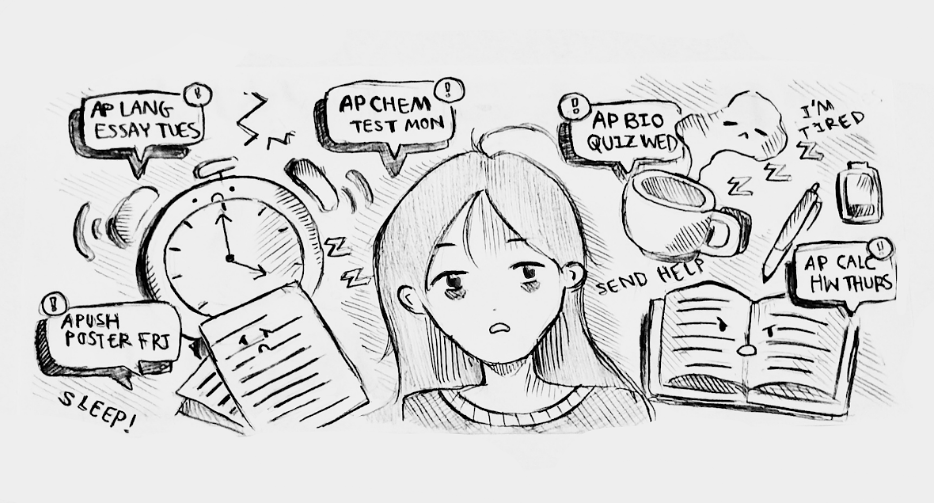
From freshmen to seniors, millions of students across the country have put in months of effort to pass the AP exam. But, how is it normal to expect so many high school students to take on a college level class? There are over 40 AP courses offered at WCHS, and many students load up on taking as many of these courses as humanely possible. The truth is, expecting such young students to take AP level classes is not a good standard to have, nor is it healthy. The stress, anxiety, and overwhelming feeling that comes with taking higher level classes should not be a regular expectation for students.
The recommended amount of AP classes for freshmen ranges from zero to one, although many students often end up taking two. Sophomores, on the other hand, are advised to take no more than two, yet many students surpass that suggestion as well. For underclassmen to attend the same courses that college students take puts too much strain on their mental wellbeing. Qualifications and expectations for colleges have skyrocketed, urging students to take an overwhelming course load to stand out amongst their peers.
The abundance of APs students are taking is the outcome of the nearly impossible college admissions process. With all Ivy League schools having under a ten percent acceptance rate, students feel the need to build an impressive resume starting young. According to College Board, the expectations for high school students have increased rapidly from achieving strong grades in standard classes to maintaining an almost perfect GPA across multiple college-level subjects, along with balancing numerous extra-curriculars. At WCHS in particular, the bar for academic excellence is constantly rising, forcing students to re-evaluate what a “normal” amount of APs should even be.
Outside of WCHS, many schools have a high standard for their students and offer similar AP classes and rigorous programs. However, WCHS is unique in that students are able to take AP U.S. history (APUSH) their freshman year. APUSH is known as one of the hardest classes offered in high school, so why is WCHS offering and even normalizing taking this class as a freshman? Freshmen sign up for this course trying to get a head start in taking as many AP classes as possible. Allowing these 14 and 15 year-olds to take one of the hardest AP classes in high school sets an unrealistic academic expectation way too early. The class itself is catered to students who are more advanced and not created for 14 year olds.
Instead of choosing subjects that spark interest, many students are instead selecting courses based on their weighted GPA potential, leading to burnout before they even step foot onto a college campus. Ultimately, the academic path students take is less a product of peer pressure and more a response to a college landscape that grows more demanding year after year leading underclassmen to go above and beyond the standard when choosing to take AP classes. However, when every students’ resume starts to look the same, these courses begin to look less like a distinction and more like a basic requirement.
The AP classes offered at WCHS are developed by the College Board in order to prepare students for college academics. Many students enjoy taking college level courses and prioritize picking APs in order to experience higher-level critical thinking and independent study skills. Each student has a unique learning style and adapts to different curriculums differently. High school is a place to build confidence and teach academic skills. Adding APs to the equation so young can cause students to sign up for them as a survival mechanism and not a place of self-reliance.