
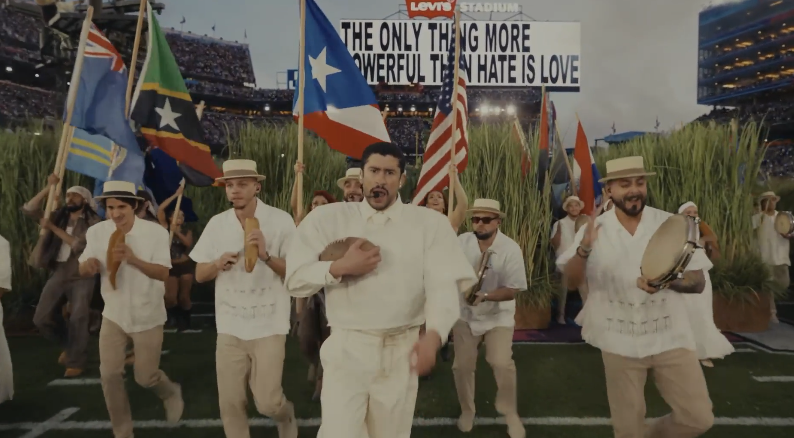
“The only thing more powerful than hate is love.” Those words flashed across the screen during the Super Bowl LX halftime show on Feb. 8, 2026, as Bad Bunny took center stage. What could have a typical performance, where fans sing along in the crowd and dance to upbeat music, became something far more meaningful. This show went far beyond the American tradition of entertainment, and was used as a platform to curate a celebration of Puerto Rican and Latin identity as well as a powerful message of worldwide unity. It was a performance carried beyond the stadium, and into the classrooms at WCHS.
Born Benito Antonio Martínez Ocasio in Vega Baja, Puerto Rico, Bad Bunny has built his career on challenging expectations of society. As one of the most streamed artists in the world and the first Spanish language headliner of the Super Bowl halftime show, his selection by the NFL marked a major cultural shift. Instead of leaning toward English hits to appeal to the majority audience, Bad Bunny performed hits in Spanish like “Tití Me Preguntó” and “El Apagón.”
“As a Puerto Rican student, seeing Bad Bunny represent Puerto Rican culture on such a large stage made me feel proud in a deep way, like Puerto Rico was not being treated as an afterthought,” WCHS sophomore Celeste Watlington said. “Seeing someone as influential as Bad Bunny representing our language, music and identity felt validating. We were finally being centered instead of toned down or translated for everyone else.”
The performance was well-planned and thoughtfully executed. Over 300 dancers filled the stage with choreography rooted in Caribbean traditions. A guest appearance was made by Puerto Rican legend Ricky Martin, where he performed “Lo Que Sucedió, Pasó,” addressing gentrification and forced displacement in Puerto Rico. Surprise guest Lady Gaga accompanied Bad Bunny during the show, performing a salsa dance to the song “Die with a Smile.” She wore a blue salsa dress with a bright red Flor de Maga brooch, the official flower of Puerto Rico.
“When Bad Bunny said ‘God Bless America’ during the halftime show and listed all the countries across the Americas, he was trying to point out that America is supposed to include North and South America, not just the United States,” WCHS sophomore Santiago Monrroy said. “I think he was slightly criticizing how the United States treats immigrants. If America includes all these countries, in both North and South America, then the people coming from them should not be treated like outsiders.”
Additionally, during the performance,flags were displayed from countries across the Americas, emphasizing the significance of national representation. At the end of the performance, Bad Bunny held a football in his hand with the words “Together, we are America” inscribed, meant to share the message of unification of individuals from different nations and cultures in America.
“I think Bad Bunny’s message delivered in the superbowl connects to themes studied at the history courses offered at WCHS,” WCHS Social Studies teacher Olivia Henry said. “In [history] class, we talk about how nationalism can be both a unifying and a dividing force. For example, nationalism unified Germany in the 19th century, but it also contributed to division in empires like Austria-Hungary before World War I. His message, that all of us in the Americas are connected, seems like an attempt to frame nationalism as something unifying rather than divisive. Instead of separating nations, it emphasizes shared identity.”
During the Super Bowl halftime show, 5-year-old Lincoln Fox held Bad Bunny’s Grammy trophy while watching the Grammys on television, representing Bad Bunny as a child. At the Grammys, Bad Bunny spoke about unity, love and the importance of recognizing all people across the Americas, highlighting issues like immigration and belonging.
“As an Argentinian I found myself relating to this performance a lot,” Monrroy said. “Many elements reminded me of my childhood and things that Hispanic families connect to. It was meaningful to see that culture represented on such a big stage. It highlighted an important part of our identity.”
While the music and costumes symbolized identity, the stage itself told a story. There was a coconut, shaved ice and barber shop connecting to broader Latin American culture. The set design also specifically reflected Puerto Rican agricultural history through sugarcane fields and agriculture workers wearing traditional pava hats. The home of an 84-year old Puerto Rican resident, referred to as “La Casita,” was used to represent rural life.
“Moments like this show how music can be more than entertainment,” Watlington said. “It can be representation, resistance and comfort all at once”