
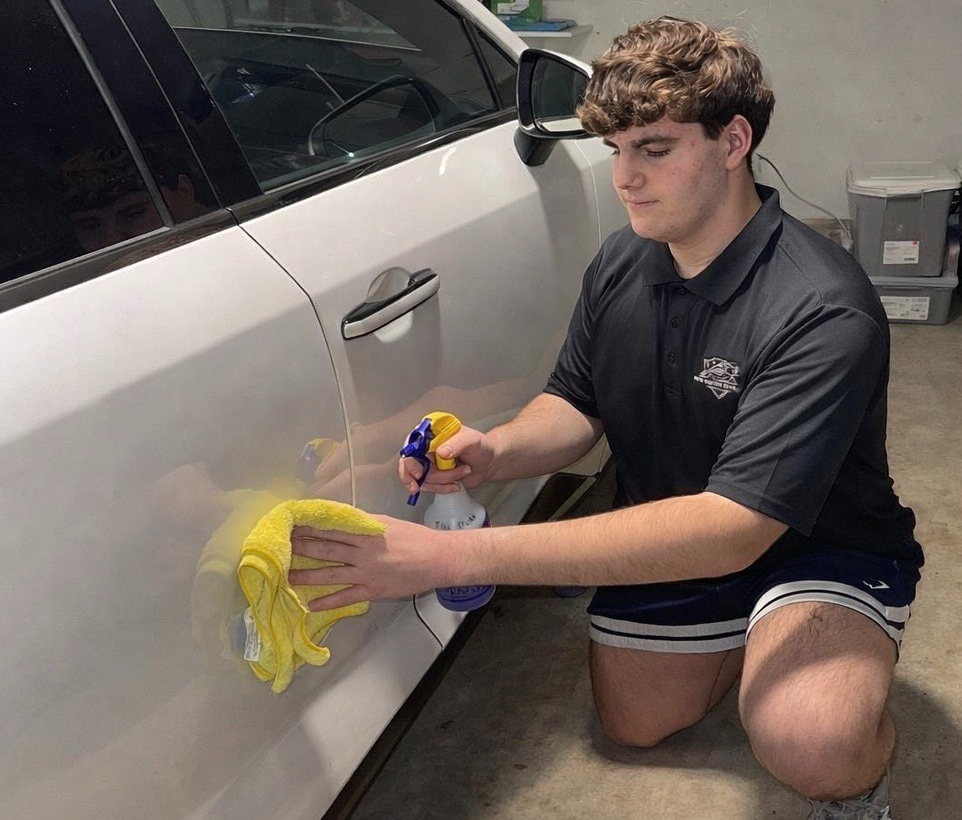
After the final school bell rings, most students move on to sports, homework or time with friends. For a select few, however, afternoons are spent learning lessons that cannot be measured by grades alone, instead focusing on responsibility, leadership and strong commitments. Sophomore Ryan Butchko spends his time running Auto Doctor Detailing, a car-detailing business he started in eighth grade after learning from his cousin. What began as a way to stay busy quickly turned into something more serious, where every car brought new pressure, higher expectations and lessons that could not be learned in the classroom.
“It’s called Auto Doctor Detailing, and we do super deep car cleaning,” Butchko said. “I wanted to get into something I could build and be proud of, and I knew this was something I could grow while also helping people in my community. So I was just like, ‘I have everything I need to start. I have all the connections I need.’”
When Butchko started car detailing, the work was far from easy. His first real experience came while cleaning his mom’s car alongside his cousin, when the process felt stressful. Butchko was not just learning how to clean a car; he was learning responsibility and accountability in a setting where mistakes mattered far more than letters on paper.
“I remember I had no other equipment,” Butchko said. “All I had was the garden hose with the little nozzle that you could adjust and some buckets. I had bought some brushes, just like super simple stuff to get the job done. I’d get all my research before trying to see what chemicals are worth [buying]. It was really stressful because I didn’t know if I was going to mess something up. Car detailing is so much different than just getting a sponge in a bucket.”
Balancing school with a growing business forced Butchko to learn crucial time management skills early. The beginning of each year is especially demanding, with varsity football practices taking up much of his afternoons. After school, his schedule depends on said practices, customer appointments, weather conditions and school deadlines.
“Time management is the big thing,” Butchko said. “I really try to block out hours for each individual thing. Having a balance between all the different activities that you have is huge, and you’re not overdoing the business and having bad grades. One detail usually takes anywhere from two to four hours for deep cleaning. Another thing is sacrificing; you’ve got to take big leaps in business. You’ve got to sacrifice time with your friends and sometimes with your family.”
Meanwhile, sophomore Anuska Verma spends her afternoons dancing and teaching beginner dance classes at Rhythmaya Dance to children aged 5 to 12 years old. Each class and age group brings new personalities and respective challenges, from shy beginners to screen-obsessed tweens struggling to follow directions.
“They were really shy; some of them were crying,” Verma said. “Some of them were not talking, and it was really hard to get them to actually do something because they were standing there like, ‘I don’t know what to do.’ After that, they get energetic. You have to help them understand that this is gonna be fun.”
As the students arrive for the weekly Thursday evening dance class at 5:30 p.m., Verma checks the space and makes sure the Bluetooth speaker is working. With tunes blasting throughout the studio, Verma is at the front, balancing students’ attention and teaching the choreography.
“You realize that you’re teaching the class alone, and there’s no one else to help you,” Verma said. “When you’re alone, you’re in charge of all these kids. I need them to know what I was told to teach by my head dance teacher. It comes down to teaching them something, and understanding ’Wait, I actually have to teach them something.’ I have a responsibility to fulfill.”
From managing young dancers to caring for clients’ cars, Verma and Butchko, like many other WCHS students, spend their afternoons being relied on by others. Those responsibilities and experiences shape their understanding of time management and leadership.
“Leadership really brings you to who you really are,” Verma said. “Like the responsibility of being in charge of a lot of these kids makes you realize [that]. It kind of trains you for being [a] leader and such rules that make you want to do it more. You have to be a leader to start the dance class and keep the [kids] motivated.”