

Technology is one of the most relied upon aspects of society, so what happens without it? Monday, Oct. 20, billions worldwide woke up to the news that many of their day-to-day platforms and applications were down as a consequence of the global outage of Amazon Web Services (AWS). While it may not be widely known, the same Amazon that offers package delivery also powers many of the world’s most reputable companies and represents the most profitable segment of the Amazon corporation.
AWS is a cloud computing platform that allows companies to rent digital infrastructure instead of maintaining their own. By offering on-demand services like data storage, computing power and pay-as-you-go features, AWS helps organizations cut costs and operate more efficiently. The outage was not just an inconvenience; it was a shutdown of the digital workspace. Major platforms such as Venmo, Uber, Netflix and Fortnite were affected, and according to the Economic Times, companies including Snapchat and Zoom lost up to $611,986 and $532,580 per hour, respectively. However, Amazon bore the brunt of the losses, losing around $73 million per hour.
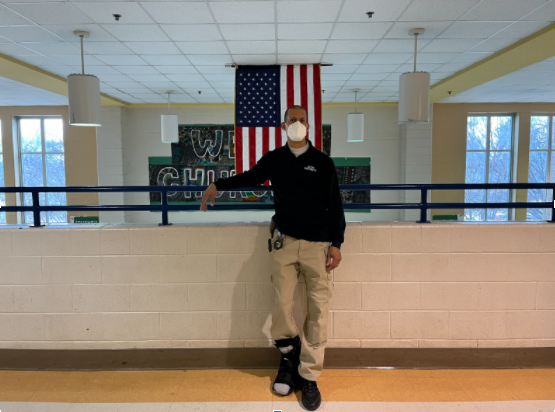
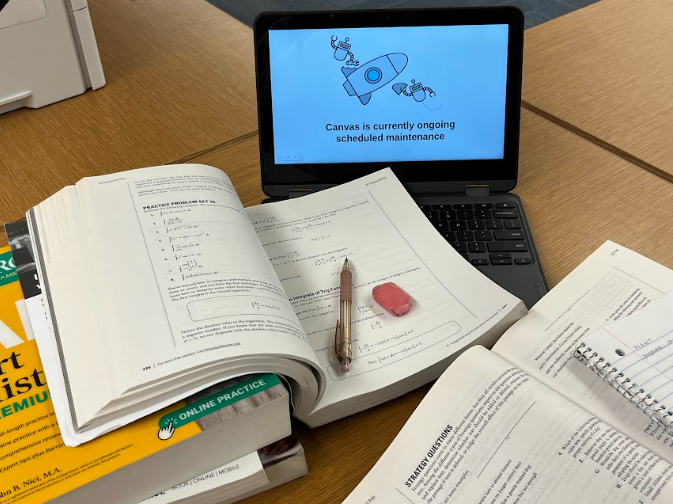
“Canvas, performance matters, Cleaver and Naviance all went down,” WCHS Honors English 10 and AP Lang teacher Alison Deli said. “I also could not get into Hub+, which is the human resources site related to MCPS employee pay.”
All of the platforms that teachers rely on to post grades, plan lessons and communicate with students suddenly became inaccessible. Many had planned to use the MCPS four-day weekend to catch up on grading as the quarter winds down, but without access to any of their usual tools, that became nearly impossible.
“I had 90 plus 10th-grade essays that I wanted to enter into Canvas, but I could not do so because of the outage,” Deli said. “I also was not able to check on what my modules looked like. And yes, it was the weekend, and yes, we did not have school, but let us face it, we as teachers use every opportunity we can to get work done, and we just could not do anything.”
With grading, lesson planning and school-wide communication all centered online, many found themselves stuck waiting around for the systems to get back online before they could make progress. But the effects of the outage did not stop with teachers. Students also felt the impact, especially those trying to get ahead before the start of the week.
“I tried to complete my homework and study for tests during the over 12-hour outage, but obviously, I was not able to,” WCHS senior Anchal Sharma said. “I had to stay up late on Monday night to complete assignments that I was not able to complete earlier in the day, which led me to be extremely tired [on Tuesday].”
Not knowing when the sites would come back left many students in the dark. Previously, the most severe technology issue faced was Wi-Fi cutting out midday, so having an outage of this caliber was a new and alarming situation. Teachers, on the other hand, are no strangers to technical difficulties.
“Synergy goes out at least once a month, whether it be that we can not take attendance or put in grades,” Deli said. “So I think teachers are used to the systems being down, but not on the scale we experienced over the weekend.”
The reason for AWS being down is still unknown. Typically, outages of this level occur from a maintenance issue, human error or a cyber attack. Earlier on Monday, before any information was known, many speculated that it was caused by a cyber attack, yet there is no evidence of one occurring.
“I did not have any concerns about my data being breached during the outage,” Sharma said. “I was not too worried about my Canvas or AP Classroom assignments being leaked, rather what was happening on the [AWS’s] end.”
Luckily, the outage occurred during a non-school day, but the ramifications could have been awful if it had occurred on a school day. However, the outage raised a bigger question, one that went beyond going a single day without access to the AWS-dependent sites: how reliant society has become on technology. This outage highlighted how dependent education has become on technology. What used to be a supplement has now become the system itself.
“This whole job has become so technical; I practically need a degree in technology,” Deli said. “At the same time, we cannot do this job without technology. I am not sure what our alternative is anymore.”